Restoring Settled and Uneven Paver Surfaces
Paver Repairs in Tampa for properties where shifting, settling, or visible deterioration affects outdoor surface safety and appearance
Pavers that have settled create low spots where water pools after storms, and lifted sections become tripping hazards that liability-conscious homeowners need to address before someone stumbles on an uneven walkway. The repair process begins with evaluating the affected surface to determine whether the problem stems from base erosion, inadequate compaction during original installation, root intrusion, or water infiltration that washed away bedding sand. Bay Brick Pavers assesses the extent of damage and determines the appropriate fix—localized re-leveling, base reconstruction, or broader surface restoration—rather than assuming full replacement is necessary when targeted repairs can restore function and appearance.
Common repair scenarios include driveways showing tire path depressions, patios with settled areas near downspouts or irrigation zones, pool decks where pavers have lifted due to root growth, and walkways displaying joint separation or individual units that rock underfoot. The repair approach depends on whether the base remains stable, whether edge restraints have failed, and whether the original pavers can be reused or require replacement due to cracking or surface wear.
Schedule an on-site assessment to identify the cause of surface deterioration and review repair options in Tampa, Brandon, Riverview, and surrounding areas in South Tampa.
How Repairs Address Underlying Causes
Effective paver repair involves removing affected units, addressing the condition that caused failure, rebuilding the base or bedding layer to proper grade and compaction, reinstalling pavers in the original or an updated pattern, and refilling joints. When tree roots have lifted sections, the repair may include root pruning, installation of root barriers, and base reconstruction with geotextile fabric to reduce future intrusion.
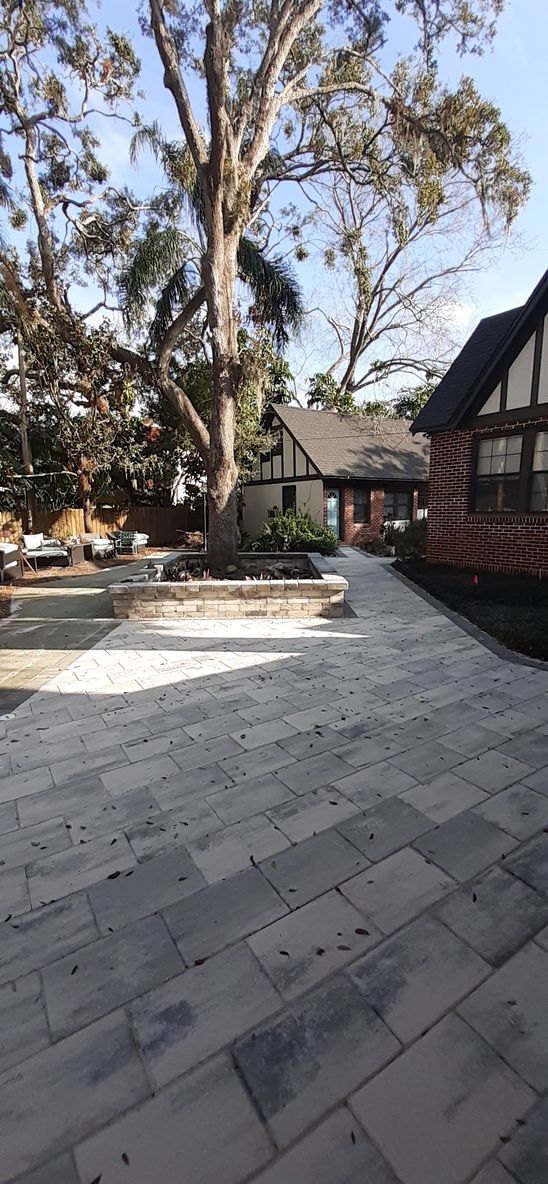
Once repairs are complete, the restored area sits level with surrounding pavers, water drains properly without collecting in depressions, and the surface provides stable footing without rocking or shifting underfoot. Walkways no longer present tripping risks, driveways support vehicle traffic without further settlement, and patios return to functional use for furniture and foot traffic.
The repair may involve matching existing paver color and style, or updating the affected area with new units that coordinate with but don't necessarily match the original installation. Decisions depend on material availability, whether a visual refresh is desired, and the extent of the repair zone.
What Property Owners Usually Ask
Repair decisions hinge on understanding what caused the problem, whether localized fixes will hold, and when broader surface work becomes the more practical option.
What causes pavers to settle or become uneven over time?
Base erosion from water infiltration, inadequate compaction during original installation, root growth from nearby trees, soil subsidence in Tampa's mixed clay and sand conditions, or edge restraint failure that allows lateral movement all contribute to surface deterioration.
How do you determine whether a repair or full replacement makes sense?
The decision depends on how widespread the damage is, whether the base remains stable outside the affected zone, the condition of existing pavers, and whether drainage or root issues will continue causing problems if not addressed through broader site correction.
Can you match the color and style of pavers installed years ago?
Matching depends on whether the original product line remains available and how much the existing pavers have weathered—in some cases, exact matches are possible, while in others, a coordinating but visibly different paver may be the only option, prompting homeowners to update a larger section for visual consistency.
What's involved in repairing a section of driveway or patio?
The process includes removing pavers from the affected area, evaluating and correcting the base or bedding layer, reinstalling pavers to proper grade and pattern, refilling joints with polymeric sand, and cleaning the surface to blend the repair zone with the surrounding area.
How long do properly executed paver repairs typically last?
Repairs that address the underlying cause—rebuilding the base, correcting drainage, installing edge restraints, or mitigating root intrusion—perform as well as new installations, while repairs that only re-level pavers without fixing base or drainage issues may experience recurring problems.
Bay Brick Pavers examines the damaged surface, identifies the cause of failure, and recommends repair strategies that restore safe, functional outdoor areas. Contact our team to arrange an evaluation of your Tampa area property's paver repair needs.